Homeowners across Dewsbury use us for block paving driveway repair, from Savile Town and Ravensthorpe out to Thornhill and nearby Batley, Ossett and Heckmondwike. We check the base and the drainage on every Dewsbury drive we price, because the surface is rarely the whole story.
Block paving has one big advantage over concrete and tarmac: when it goes wrong, it can be taken up and put back. Dewsbury Landscaping & Driveways offers block paving driveway repair to homeowners throughout Dewsbury whose paved drives have sunk, cracked, lost their jointing sand or started to spread. The service is for anyone with a block paved drive, path or patio that is still mostly in good order but has developed faults in particular areas.
Block paving drives in Dewsbury fail for predictable reasons. Sub-base that was too thin or poorly compacted settles under car wheels. Edge restraints that were not haunched in concrete give way and the blocks drift apart. Jointing sand washes out, weeds get in and the blocks start to rock. None of these things means the drive is finished.
Our repairs follow the same BS 7533 principles as a new installation. We lift the affected blocks, fix the problem underneath, re-lay on fresh sharp sand and re-sand the joints. Done properly, a repaired section is indistinguishable from the rest of the drive once the blocks have weathered back in.
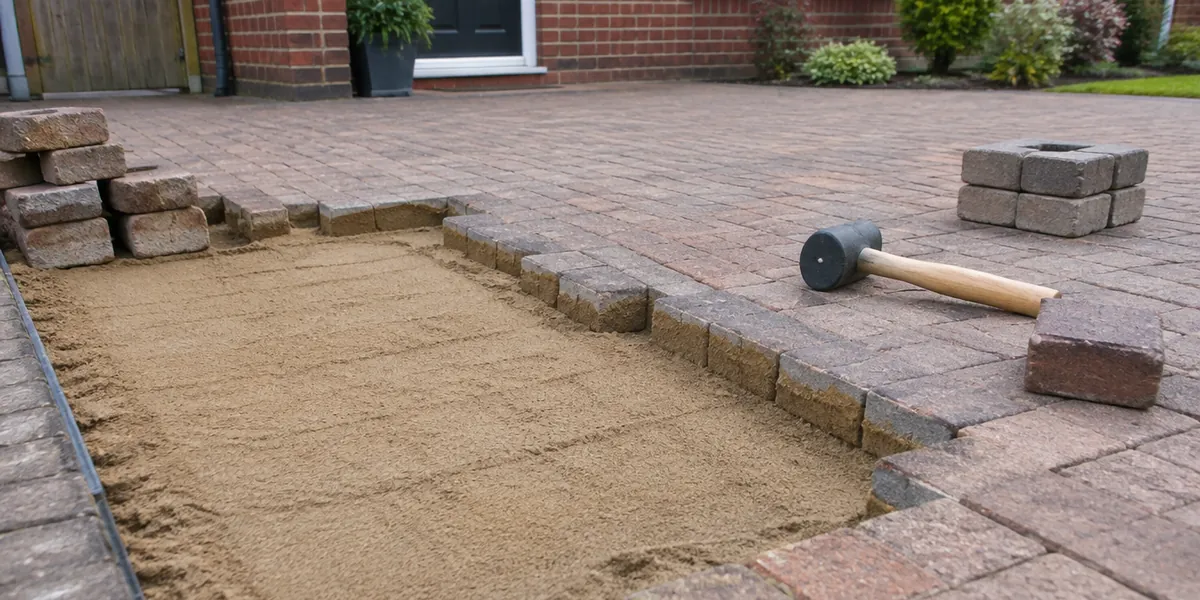
Sunken Block Paving Relevelling
Sunken patches are the most common block paving fault we repair across Dewsbury. They show up as dips where the car wheels sit, hollows around manhole covers and gullies, and sagging along a service trench. The blocks themselves are usually fine; the problem is in the bedding sand and sub-base beneath.
We start by lifting the blocks over the sunken area plus a margin of sound paving around it, marking the pattern so it goes back the same way. Then we look at what we have. If the bedding sand has simply washed out or migrated, we remove it, check the sub-base is firm and re-lay fresh sharp sand screeded to the right level. If the sub-base has failed we dig it out, re-fill with Type 1 MOT compacted in layers and screed over the top.
Around manholes and gullies the fault is often that the frame was never bedded on concrete and has dropped. We re-bed the frame on a mortar collar first, then re-lay the paving around it. Along trench lines we compact the backfill in thin layers rather than in one go, because loose backfill is what caused the dip in the first place.
The relaid blocks are compacted with a plate compactor fitted with a rubber mat, joints are filled with kiln-dried sand and the area is compacted again until the sand stops settling. The result should be a flat surface with proper falls so water runs off to a drain rather than sitting in the middle.
Broken Block Replacement
Individual blocks crack when they are overloaded on a soft bed, when a heavy skip or delivery lorry is parked on a domestic drive, or when a block was a factory second to begin with. Replacing single blocks or small groups is the simplest repair we do, but matching them is where the skill lies.
Concrete block paving changes colour as it weathers, and manufacturers change their ranges every few years. If you have spare blocks left from the original installation, those are the best match. If not, we identify the product by size, chamfer and colour blend and source the nearest equivalent. On an older Dewsbury drive we sometimes take blocks from under a bin store or behind a gate for the visible repair and put the new blocks in the hidden spot.
To remove a broken block without damaging its neighbours we break it out in pieces with a chisel, or use a pair of block extractors on a sound one. The bedding sand is cleaned out and topped up, the new block is tapped down to level with a rubber mallet and the joints are sanded. Where several blocks have cracked in the same area we check the bedding and sub-base underneath, because a cluster of cracks usually means the base is soft and the real repair is relevelling.
Clay paving blocks are handled the same way, though they are harder to break out cleanly.
Block Paving Joint Repair
Jointing sand is what locks a block paved surface together. Without it the blocks move independently, rock under load, chip at the edges and let water straight through to the bedding layer. Over a few years of rain and pressure washing most Dewsbury drives lose a good part of their joint sand, and weeds and moss take over the gaps.
We begin by clearing the joints. A pressure washer with a rotary head run along the joints, not across them, removes old sand, moss and weed roots to a depth of at least 20 mm. Stubborn weeds are treated first so they do not regrow under the new sand. The surface is then left to dry completely, because sand will not flow into damp joints.
For most drives we brush in kiln-dried silica sand, compact the surface with a plated compactor to vibrate the sand down, then brush and compact again until the joints are full. Where you want longer-lasting joints we can use a polymeric jointing sand, which is swept in dry, misted with water and sets to a firm but flexible joint that resists weeds and washout. It needs a fully dry surface, so we schedule it for a settled spell of weather.
Once the joints are full the drive can be sealed. A good sealer binds the surface sand, resists oil stains and slows weed growth, and we can carry that out as part of the same visit or as a separate job.
What You Get When We Handle Your Block Paving Driveway Repair
Block paving repair is detail work: lifting blocks without chipping them, screeding a small area to match the paving around it, tracking down a discontinued block. Our team has done a lot of it across Dewsbury and we treat a repair with the same care as a new drive.
We put the cause right, not just the surface. If a drive has sunk because the sub-base is thin, we tell you, and we replace it rather than topping up the sand so the dip comes back next year. Every repair comes with an itemised written quote and a written guarantee.
We are insured, registered to carry away waste and happy to work around your parking so you are not without the drive for longer than necessary. If the drive has reached the point where repairs are no longer worth it, we also install new block paving and can quote for a full relay using your existing blocks.
Our Block Paving Driveway Repair Process
- Assessment: we check the extent of settlement with a straight edge, test the edge restraints and look for the cause beneath the surface.
- Written quote: a clear, itemised quote for the repair with any options such as polymeric sand or sealing listed separately.
- Lifting: blocks over the affected area are lifted carefully and the pattern recorded so it can be put back the same way.
- Base repair: bedding sand is replaced and, where needed, the sub-base is excavated, re-filled with Type 1 MOT and compacted in layers.
- Relaying: blocks are relaid on screeded sharp sand, with broken ones replaced by matched blocks, and compacted with a rubber-matted plate.
- Jointing: joints are filled with kiln-dried or polymeric sand and compacted until they stay full.
- Clean-up and handover: surplus sand is removed, waste taken away and the written guarantee handed over.
Small repairs in Dewsbury are usually done in a day. Larger relevelling jobs take two or three. The drive can normally be used as soon as we finish, apart from polymeric sand which needs a day to set.
How Block Paving Driveway Repair Is Priced in Dewsbury
The area that needs lifting is the main driver. A sunken patch of a couple of square metres is a short job; relevelling the full width of a drive where cars park is a longer one. What we find underneath matters as well: topping up bedding sand is quick, but excavating and replacing failed sub-base takes much more time and material.
Block matching affects the price when the original product is discontinued and we have to source alternatives or swap blocks from hidden areas. Edge restraint repairs, where a kerb has to be re-set on concrete, add to the work.
For joint repair the cost depends on the size of the drive, the condition of the joints and whether you choose kiln-dried or polymeric sand. Access across Dewsbury varies a lot, and a terraced frontage with no van access takes longer than a detached house with a wide drive.
Block Paving Driveway Repair Throughout Dewsbury
Our block paving repair team covers the whole of Dewsbury. If your paved drive in Thornhill or Ravensthorpe is twenty or more years old, it is probably due for relevelling and re-sanding. In Earlsheaton we often replace blocks damaged by skips and deliveries, which happens most where a frontage is narrow, and in Chickenley settlement around drainage covers is a regular job. Savile Town brings us plenty of joint repair and sealing work on larger drives. We also travel to nearby Batley, Ossett and Heckmondwike beyond Dewsbury for repairs of any size.
If this is part of a bigger project, see our pages on concrete driveway repair and tarmac driveway repair.
Common Questions
Can sunken block paving be fixed without replacing the whole drive?
Yes. Because the blocks are laid loose on sand, we lift only the affected area, fix the bedding or sub-base beneath and relay the same blocks. The repaired section blends in because it uses the original paving. Replacing the whole drive is only necessary when the sub-base has failed across most of it or the blocks are badly worn throughout.
Will you be able to match my existing blocks?
Usually. If you kept spares we use those. Otherwise we identify the product and source the nearest match, or move weathered blocks from a hidden part of the drive into the visible repair and put new ones where they will not be noticed. A new block will look brighter for a season or so before it weathers to match.
Why do weeds keep growing in my block paving joints?
Weeds grow in the joints when the jointing sand has washed out and been replaced by wind-blown soil and moss. The fix is to clean the joints out properly, treat any roots, re-sand with kiln-dried or polymeric sand and ideally seal the surface. Pressure washing across the joints without re-sanding afterwards makes the problem worse.
How often should block paving be re-sanded?
On a typical Dewsbury drive the joints need topping up every two to four years with kiln-dried sand, sooner if the drive is pressure washed regularly or sits on a slope where rain runs across it. Polymeric sand lasts considerably longer. Sealing the surface after sanding extends the life of the joints further.
Do I need to move my car during the repair?
We need the repair area and a margin around it clear while we work, so for most jobs the drive is out of use for the day. We can usually leave part of a wider drive usable. We will tell you in the quote how long you will be without parking and plan the work around your needs where we can.