Homeowners across Dewsbury use us for garden drainage installation, from Chickenley and Earlsheaton out to Savile Town and nearby Batley, Ossett and Heckmondwike. Each Dewsbury job starts with finding where the water comes from and where it can go, before we suggest a fix.
If your lawn is underwater every time it rains hard, or the patio holds a puddle against the back door for days, the garden needs a drain. Dewsbury Landscaping & Driveways installs garden drainage for homes across Dewsbury: French drains that intercept water moving through the soil, gullies and channel drains that collect surface water from paving and lawns, and soakaways that let that water disperse safely into the ground. The service is for anyone whose garden stays wet long after the rain has stopped, whose paving drains towards the house, or who is about to build a patio or lay a lawn and wants it to stay dry.
Drainage is designed, not guessed. Before we quote we dig a trial hole in your Dewsbury garden to see the soil profile and, where a soakaway is on the table, we run a percolation test to measure how quickly the subsoil takes water. That decides whether a soakaway will work or whether we need to connect to a surface-water drain or shape a swale instead. The drains themselves use perforated pipe, clean stone and geotextile laid to a measured fall. Everything is quoted in writing, installed by our own team, and covered by a written guarantee.
Where We Offer French Drain Installation
A French drain is a trench filled with stone around a perforated pipe, and it is the most useful drainage tool in a Dewsbury garden. It works by giving water in the soil an easier path than the soil itself: water moving sideways through wet topsoil hits the stone, drops into the pipe and is carried away to an outlet.
It is the right choice where a lawn or bed stays saturated, where water runs down a slope and collects against a patio, fence or wall, or where a neighbour's higher ground drains onto yours. Laid along the uphill edge it intercepts water before it arrives; laid in a herringbone across a flat, wet lawn it draws water out of the whole area.
We dig the trench 400 to 600 mm deep and around 300 mm wide, to a fall of at least 1 in 100 towards the outlet. The trench is lined with a non-woven geotextile to keep silt out of the stone, then a 100 mm bed of clean 20 mm gravel, then 100 mm perforated land drain pipe with the holes facing down, then more gravel to within 100 mm of the surface. The trench is finished with topsoil and turf or left as a gravel strip.
What affects the result is the fall, the outlet and the stone. A drain with no fall or no outlet is a stone-filled trench that fills up and stays full, so we always connect to a soakaway, a surface-water drain or a ditch with permission, and we use washed gravel, not crushed fines that clog.
Garden Gully Installation
A gully is a collection point for surface water. Where a French drain deals with water in the soil, a gully deals with water running over a hard surface or pooling in a low spot on a lawn. Many Dewsbury patios laid without thought for drainage end up needing one, because rain that used to soak into lawn now runs off paving.
We fit two kinds. A point gully is a grated trap set at the lowest point of an area, connected by 110 mm or 80 mm solid pipe to a soakaway or surface-water drain. A linear channel drain is a long, narrow grated channel set flush with the paving, usually along the edge where a patio meets the house wall, across a door threshold or at the bottom of a sloped drive.
Installation means setting the gully or channel on a concrete bed at exactly the right level so the surrounding surface falls to it. We cut paving to suit, haunch the channel in concrete, and run the outlet pipe with a fall of 1 in 80 or better. Gratings are chosen for the traffic: pedestrian grade for a patio, heavier for a drive.
A gully only works if the ground around it falls towards it, so we check levels with a laser before fixing the position, and where a patio has been laid flat we may propose relaying the nearest row of slabs to create the fall.
Soakaway Installation
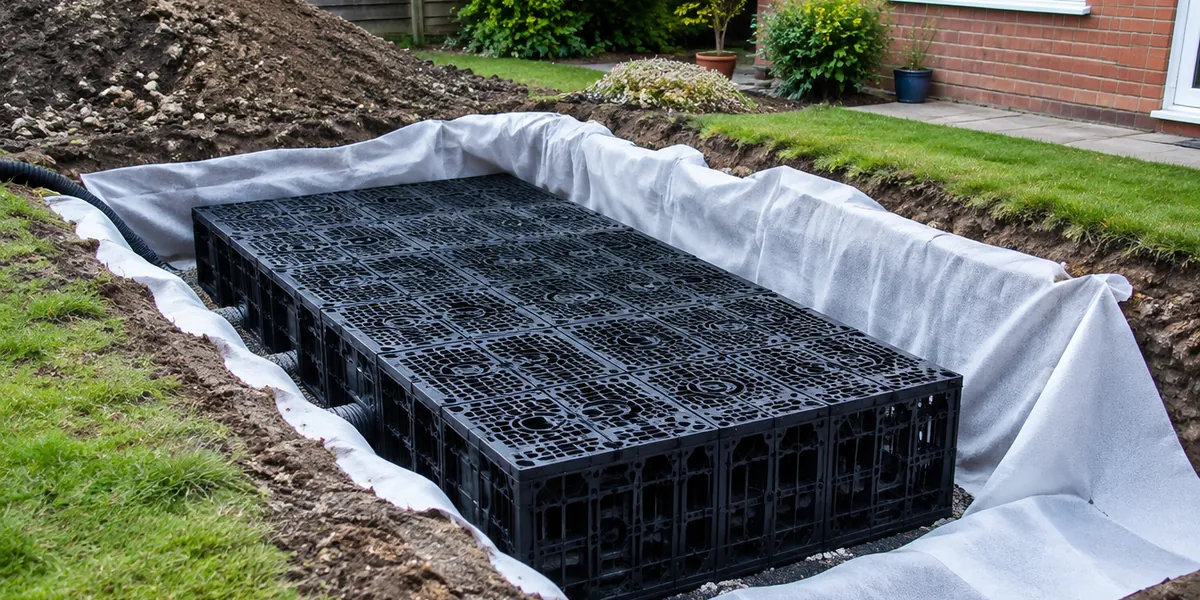
A soakaway is where drained water ends up. It is an underground void that fills quickly in a storm and empties slowly into the subsoil. Modern soakaways use modular plastic crates wrapped in geotextile, which hold far more water per cubic metre than the old rubble-filled pit and do not silt up in the same way.
Soakaway installation is the right choice when there is no surface-water drain to connect to, or when the water company will not accept extra flow, and when the subsoil is permeable enough to take the water. That last point is why we test first. A percolation test, digging a pit and timing how fast it empties, tells us the infiltration rate of your Dewsbury subsoil and lets us size the soakaway for the area draining into it. Sandy and gravelly ground takes water well; heavy clay may not, and a soakaway in clay will overflow.
The pit is excavated at least 5 m from any building and clear of boundaries and tree roots, usually 1 to 1.5 m deep. We lay a 100 mm bed of gravel, line with geotextile, assemble the crates, connect the inlet pipe through a silt trap so grit never reaches the crates, wrap the geotextile over and backfill with gravel then topsoil. A lawn, bed or even light paving can go over the top.
What affects the outcome is sizing and the silt trap: an undersized soakaway floods in the first big storm, and one without a silt trap blocks within a few years.
Why Choose Us for Garden Drainage Installation in Dewsbury
Drainage fails for simple reasons: no fall, no outlet, no geotextile, the wrong stone, a soakaway dug in clay without a test. We do none of those things.
We also think about the whole Dewsbury garden. Drainage installation is often the first stage of a patio, a lawn or a planting scheme we are building, and we design the drains to suit what is coming. If the problem is really one of levels, we will tell you and suggest garden levelling and grading instead, and if a bank is washing out we will point you to erosion control.
Quotes are written and itemised. Our team is insured and we are registered waste carriers, so trench spoil leaves site properly. The installation comes with a written guarantee and a drawing showing what is underground.
Garden Drainage Installation: Step by Step
- Site visit, ideally after rain. We look at where water sits, where it comes from, what the ground falls to and where an outlet could be.
- Trial hole and percolation test. We dig to see the soil layers and, for a soakaway, time how fast the subsoil takes water.
- Design and written quote. You receive a drawing of drain runs, gully positions, falls and the outlet or soakaway, with an itemised quote.
- Setting out and service check. Routes are marked with paint and pegs, and we check for buried services, roots and boundaries before digging.
- Excavation to fall. Trenches and pits are dug to the planned depth and gradient, checked with a laser level as we go.
- Installation. Geotextile, stone, perforated pipe, gullies, silt traps and crates are installed and the system tested with a hose before backfilling.
- Reinstatement and handover. Topsoil, turf or paving goes back, and we leave an as-built plan showing every drain and outlet.
Most domestic drainage installations in Dewsbury take between one and four days depending on the length of drain runs and whether a soakaway is included.
What Affects the Cost of Garden Drainage Installation in Dewsbury
The length and depth of the drain runs is the first factor. A single French drain along one edge of a lawn is a small job; a herringbone system across a large waterlogged garden is several days of digging and a lot of stone. Depth matters because deeper trenches mean more spoil to remove and more stone to replace it.
The outlet is the second. Connecting to an existing surface-water drain nearby is straightforward; installing a soakaway means a large excavation, crates, geotextile and a silt trap. Soakaway size, and so cost, depends on the percolation rate of the Dewsbury subsoil and the area being drained.
Ground conditions and access affect labour. Heavy clay, tree roots, existing paving to lift and relay, and gardens reached only through the house all slow the work. Spoil disposal is priced on volume. Finally, the choice between point gullies and linear channel drains, and the grade of grating, changes the materials cost. Every quote is itemised so you can see each element.
Garden Drainage Installation Around Dewsbury
We install garden drainage across the whole of Dewsbury. If your lawn in Thornhill or Ravensthorpe stays wet on heavier ground, a French drain and a carefully sized soakaway will usually sort it. If your patio in Earlsheaton drains towards the house, a channel drain and gully usually solve it. If your garden in Chickenley or Savile Town is older, it may need a combination of all three. Wherever you are in Dewsbury or nearby Batley, Ossett and Heckmondwike, we can visit, dig a trial hole and give you a written quote.
Related services we offer across Dewsbury include garden drainage and levelling.
Common Questions
How deep should a French drain be?
For a domestic lawn or border, 400 to 600 mm is typical, with the pipe sitting on 100 mm of gravel at the bottom. It needs to be deep enough to sit below the wet topsoil layer and to reach the outlet with a fall of at least 1 in 100. On heavy clay in Dewsbury we sometimes go deeper to reach a more permeable layer.
Can garden drainage be connected to the sewer?
Garden drainage can go to a surface-water drain, which many houses have taking roof water. It must never go to a foul sewer, and on a combined system the water company's agreement may be needed. Where no suitable drain exists, a soakaway is the usual answer, sized from a percolation test and sited at least 5 m from the house.
How do you know if a soakaway will work in my garden?
We dig a test pit, fill it with water and time how long it takes to drain, usually repeated to get a reliable figure. That gives an infiltration rate for your subsoil. If the rate is reasonable we size the soakaway from it and the area being drained. If the pit is still full the next day, a soakaway is not the answer and we propose an alternative.
Will installing drainage ruin my lawn?
There is disturbance along the trench lines, but we lift turf in neat strips, keep spoil on boards and relay or returf when the drain is in. In the growing season the lines green over within a few weeks. If the lawn is poor anyway, many Dewsbury customers take the opportunity to have it levelled and returfed once the drainage is complete.
Does a French drain need maintenance?
Very little if it is built with geotextile and washed stone. The outlet and any silt trap should be checked once a year and cleared of leaves and silt. A drain that was built without geotextile, or with crushed stone full of fines, will slowly clog and may need rebuilding. We fit rodding access on longer runs so they can be cleared if needed.