We take on flowering plant care right across Dewsbury and its WF12 and WF13 postcodes, from Savile Town and Chickenley to Thornhill, plus nearby Batley, Ossett and Heckmondwike. We visit, measure and talk through the options with you first, then send a written, itemised quote for your Dewsbury garden.
Flowering plants are the reason most people in Dewsbury have a garden at all, and they are also the part that needs the most regular hands-on attention. Dewsbury Landscaping & Driveways provides a flowering plant care service for homeowners who want borders, containers and bedding displays that keep performing from the first daffodils to the last dahlias. The service covers deadheading, lifting and dividing perennials, and swapping out seasonal bedding, and it suits anyone from a keen gardener who has run out of time to a landlord keeping a rental property presentable.
The difference between a border that flowers for three weeks and one that flowers for three months is almost entirely down to timing. Deadhead a hardy geranium at the right moment and it flowers again in August. Leave it and it sets seed and sulks. Divide a clump of crocosmia every few years and it stays vigorous; leave it and the centre dies out. None of this is complicated, but it has to be done when the plant needs it rather than when the diary allows.
Our team visits gardens across Dewsbury on a schedule planned around what you have growing. Where the problem is with the soil or weeds rather than the plants, our Garden Bed Care service deals with that, and persistent pest or disease trouble is handled under Ornamental Plant Health.
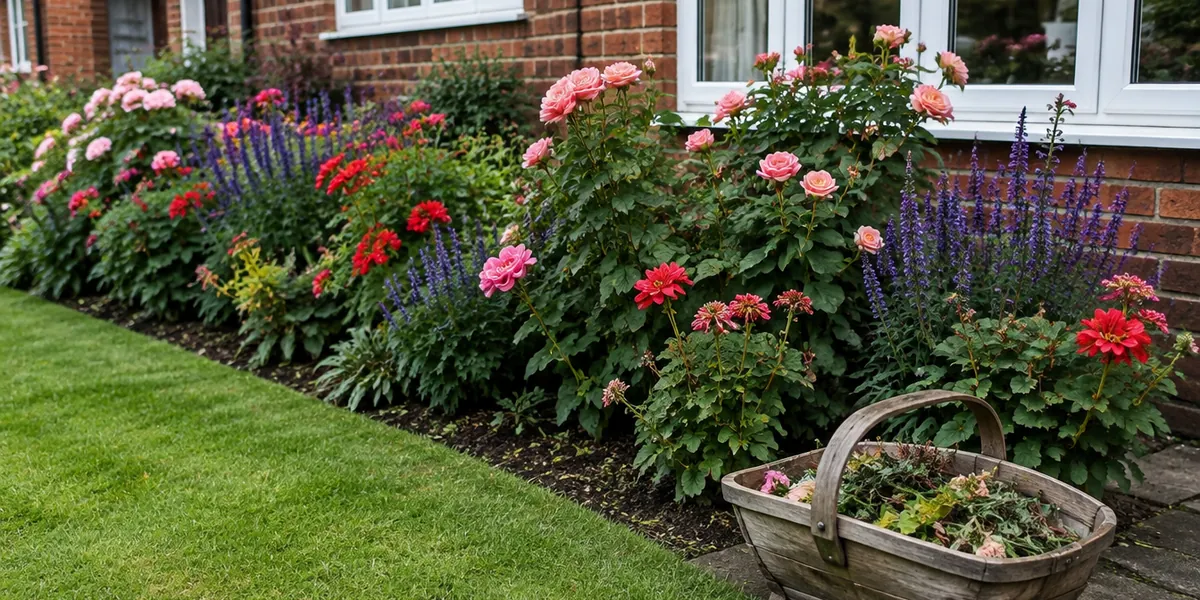
Deadheading
Deadheading is the removal of spent flowers before a plant can put its energy into seed. For most annuals, many perennials and nearly all roses, it is the single most effective thing you can do to extend the flowering season. The plant reads the loss of its flower as a failure to reproduce and tries again.
How we do it depends on the plant. Roses are cut back to the first outward-facing leaf with five leaflets, which encourages a strong new shoot rather than a weak one. Dahlias, cosmos and sweet peas are snipped just above a leaf joint, and with sweet peas it has to be done every few days in July or they stop flowering altogether. Hardy geraniums, nepeta and alchemilla get a harder treatment: we shear the whole plant back to a few centimetres once the first flush is over, feed and water it, and it comes back fresh within three weeks. Lavender is trimmed back to just above the old wood once the flowers fade, never into it.
Some plants we leave alone on purpose. Seed heads on sedum, echinacea, allium and ornamental grasses look good through winter and feed birds, so we agree which beds stay standing until February. Hydrangea heads stay on until spring to protect the buds beneath from frost.
In Dewsbury the busiest deadheading period runs from June to September. A rose garden wants fortnightly attention in summer; a mixed border of shrubs and late perennials can manage with a monthly visit.
Perennial Division
Herbaceous perennials grow outwards from the crown, and after three to five years many of them start to die back in the middle, leaving a ring of weaker growth around a bare centre. Flowering drops off, the clump crowds its neighbours and it becomes a weed trap. Division fixes all of that and gives you free plants into the bargain.
The method is straightforward but needs some strength and the right timing. We lift the whole clump with a border fork, shake or wash off the soil, and split it. Fibrous-rooted plants such as asters, heleniums and hardy geraniums pull apart by hand or with two forks back to back. Tougher crowns, including hostas, daylilies and astilbes, are cut with a sharp spade or an old bread knife. We keep the vigorous outer sections, discard the woody centre, and replant the best pieces at the original depth in soil we have improved with compost, watering them in well.
Timing depends on the plant. Spring-flowering perennials are divided in late summer or autumn; summer and autumn flowerers are best split in early spring as growth restarts. Irises are lifted six weeks after flowering in midsummer, with the rhizomes replanted at the surface. We avoid frozen ground and hosepipe bans, because new divisions need water to settle.
We tell you which clumps in your Dewsbury garden are due for division on each visit, and the spares can fill gaps elsewhere in the border, go into pots, or go to a neighbour.
Seasonal Bedding Replacement
Bedding plants give a garden colour exactly where and when you want it, and they are the quickest way to make a front garden or a set of containers look cared for. The trade-off is that they are temporary, and someone has to clear the old display and plant the new one twice a year. We do that for homeowners across Dewsbury.
There are two main changeovers. In late May or early June, once the risk of frost has passed, the spring display of wallflowers, forget-me-nots, pansies and tulips comes out and the summer planting goes in: geraniums, begonias, petunias, lobelia, cosmos and whatever else suits the position. In late September or October the summer plants are cleared and replaced with winter and spring bedding, usually pansies, violas, primulas, polyanthus, cyclamen and ornamental cabbage, with spring bulbs planted beneath them.
Each changeover follows the same routine. We remove the old plants and roots, fork over the soil, add a slow-release fertiliser, then plant at the right spacing so the display fills out without overcrowding. Containers get fresh compost rather than a top-up, because last season's compost holds little nutrient and plenty of vine weevil eggs. Everything is watered in thoroughly.
We source bedding from local nurseries where we can, chosen for the aspect of each bed. A shaded north-facing bed in Dewsbury gets impatiens and begonias rather than petunias, which sulk without sun. Hanging baskets are lined, planted and hung, and emptied at the end of the season.
Why Dewsbury Homeowners Choose Us for Flowering Plant Care
Flowering plant care is easy to do badly. Deadhead a rose at the wrong point and you get a weak shoot; divide a clump at the wrong time and you lose it. Our team in Dewsbury knows which plants want cutting back hard, which want a light snip and which want leaving alone, and we bring that knowledge to every visit rather than treating a border as something to be tidied with shears.
We plan visits around the plants you actually have, not a generic calendar. Bedding is chosen for your aspect and soil, and listed on the written quote so you know what is going in before we plant it. Divisions are replanted where they will do most good, and spares are offered to you first. All prunings and spent plants leave with us as registered waste carriers.
Everything we plant is covered by a written guarantee. If a bedding display fails to establish for a reason we could have avoided, we replace it.
Flowering Plant Care: Step by Step
- Garden walk-through: we identify what you have growing in each bed and container, note its condition and talk about the look you want.
- Seasonal plan: you receive a written schedule showing which visits cover deadheading, division and bedding changeovers, with a quote for labour and plants.
- Spring visit: we cut back old growth, divide summer-flowering perennials, feed the beds and plant up any gaps.
- Summer visits: regular deadheading, tying in and feeding, timed to the plants that need it most.
- Bedding changeover: old displays are cleared, soil refreshed and the new season's plants put in at the right spacing.
- Autumn visit: spring-flowering perennials are divided, bulbs planted and seed heads left or cleared as agreed.
- Review: we note what performed well in your Dewsbury garden and adjust next year's plant choices.
Many of our customers in Dewsbury pick up the deadheading themselves once they have seen it done and keep us for the heavier seasonal work.
Flowering Plant Care in Dewsbury: What Changes the Price
Visit frequency has the largest effect. A rose border or a run of hanging baskets in full summer wants attention every fortnight, while a shrub-based border with a few perennials can be kept on a monthly cycle. The number and size of beds and containers follows directly from that.
Plant costs vary with what you choose. Standard bedding in trays is modest; specimen plants, named-variety tulips or large containers filled from scratch cost more, and we show these as separate lines on the quote. Fresh compost for containers and slow-release fertiliser are listed too.
Division is priced by the clump: a hosta the size of a dustbin lid takes longer than a clump of asters. Access in Dewsbury gardens plays a part, since carrying trays of bedding and bags of compost through a house adds time. The written quote sets out every item.
Flowering Plant Care Throughout Dewsbury
Our flowering plant care rounds take in every part of Dewsbury. If your garden in Thornhill is established, its mature perennial clumps may be overdue for division, and any roses repay fortnightly deadheading. In Ravensthorpe we plant up a lot of front-garden bedding and window boxes, which make the most of colour in a tight space. If you have a container or courtyard garden in Earlsheaton, seasonal changeovers make up most of the work. If you have a larger plot with mixed borders in Chickenley or Savile Town, a monthly summer visit suits it. We also travel out to nearby Batley, Ossett and Heckmondwike for regular customers.
Related services we offer across Dewsbury include garden maintenance and ornamental plant health.
Your Questions Answered
When is the best time to divide perennials in Dewsbury?
Split summer- and autumn-flowering perennials in early spring as the new shoots appear, and spring-flowering ones in late summer or autumn after they have finished. Bearded irises are the exception and are divided about six weeks after flowering. Avoid frozen ground and dry spells, because newly divided plants need steady moisture to establish.
Which plants should not be deadheaded?
Anything grown for its seed heads or berries: sedum, echinacea, alliums, honesty, ornamental grasses and most shrubs with autumn fruit. Hydrangea flower heads should stay on over winter to shield the buds beneath. We agree with you which beds get a crisp tidy and which are left standing for structure and wildlife until late winter.
How many times a year do you change bedding plants?
Twice is usual. Summer bedding goes in late May or early June once frosts have finished, and winter and spring bedding replaces it in late September or October, with bulbs planted underneath. Some customers in Dewsbury add a third change for a specific event or to swap tired midsummer plants for late-season colour such as chrysanthemums.
Do you supply the bedding plants or do I buy them?
Either works. We normally source plants from local nurseries so we can choose varieties suited to the aspect of each bed and bring them on the day of planting. The plants and compost are itemised on the written quote. If you prefer to buy your own, we will plant whatever you have, though we cannot guarantee plants we did not supply.
Will deadheading really make my roses flower for longer?
Yes, for repeat-flowering roses, which is most modern varieties. Cutting the spent bloom back to a strong outward-facing leaf stops the plant forming hips and prompts a new flowering shoot within a few weeks. Once-flowering old roses and ramblers do not repeat regardless, so with those we leave the hips for autumn colour.