Homeowners across Dewsbury use us for decking installation, from Ravensthorpe and Thornhill out to Chickenley and nearby Batley, Ossett and Heckmondwike. We check the 30 cm permitted development height before quoting, and tell you up front if a raised deck would need planning permission.
Decking gives a garden a level, warm surface to sit out on, and it is often the simplest answer to a slope or an awkward space outside the back door. Dewsbury Landscaping & Driveways designs and builds decks for homeowners in Dewsbury in softwood, hardwood and composite boards, from a small platform by the kitchen doors to a multi-level deck stepping down a sloping garden.
Decking suits gardens where digging out for a patio would mean moving a lot of soil, where the ground is uneven, or where you want a raised area looking over the lawn without building a retaining wall. It also goes down faster than paving. The trade-off is that timber needs looking after, and every deck depends on the frame underneath being built properly.
We build each deck on a treated joist frame at the correct spacing for the boards, with a weed membrane below, ventilation around the frame and stainless or coated fixings throughout. Before anything is designed we check the height. A deck within 30 cm of the ground is normally permitted development; anything higher needs planning permission, and we will tell you at the survey.
Softwood Decking
Softwood decking is pine or redwood that has been pressure-treated, meaning preservative is forced deep into the timber so it resists rot and insects. It is the most common and economical choice, and the right one for most family gardens, a first deck or a raised platform that needs a lot of timber. Boards are usually 28 to 32 mm thick and 120 to 145 mm wide, grooved on one face and smooth on the other.
The frame matters more than the boards. We build it in treated C16 or C24 joists, with any timber in or near the ground rated for ground contact, fixed to posts set in concrete or to adjustable pedestals on a firm base. For boards of that thickness we space joists at no more than 400 mm centres, closer for diagonal layouts. Underneath goes a weed membrane covered with gravel, and we leave gaps around the frame so air can move.
Boards are fixed with two stainless or coated decking screws at each joist, with a gap of around 5 mm between boards for drainage and movement. Every cut end is brushed with end-grain preservative. Softwood needs a clean and a coat of decking oil or stain every year or two, and in shady corners we can fit anti-slip inserts, because any timber gets slippery once algae builds up.
Hardwood Decking
Hardwood decking is cut from dense species such as balau, ipe, garapa or oak. It is heavier, harder and naturally more resistant to rot than softwood, with a finer finish and fewer knots. It suits gardens where the deck is the centrepiece, where you want a rich colour, or where a long-lasting timber surface is worth paying more for. We source hardwood with FSC or PEFC certification, so its origin is documented.
Hardwood is too dense to screw straight into, so every fixing hole is pre-drilled and countersunk. We use stainless steel screws or hidden clip systems, since ordinary steel reacts with the tannins in some species and leaves black stains. The frame is built as for softwood, with treated joists at close centres and good ventilation underneath, because even durable boards last longer when they dry quickly after rain.
Left untreated, hardwood weathers to a silver grey within a season or two, which many people like. To keep the original colour it needs a hardwood oil once or twice a year. New boards can bleed brown tannin in the first few rains, which may mark pale paving or render next to them, so we plan the run-off away from patios and walls. Hardwood costs more to buy and takes longer to lay, but the boards themselves need little more than cleaning.
Composite Decking
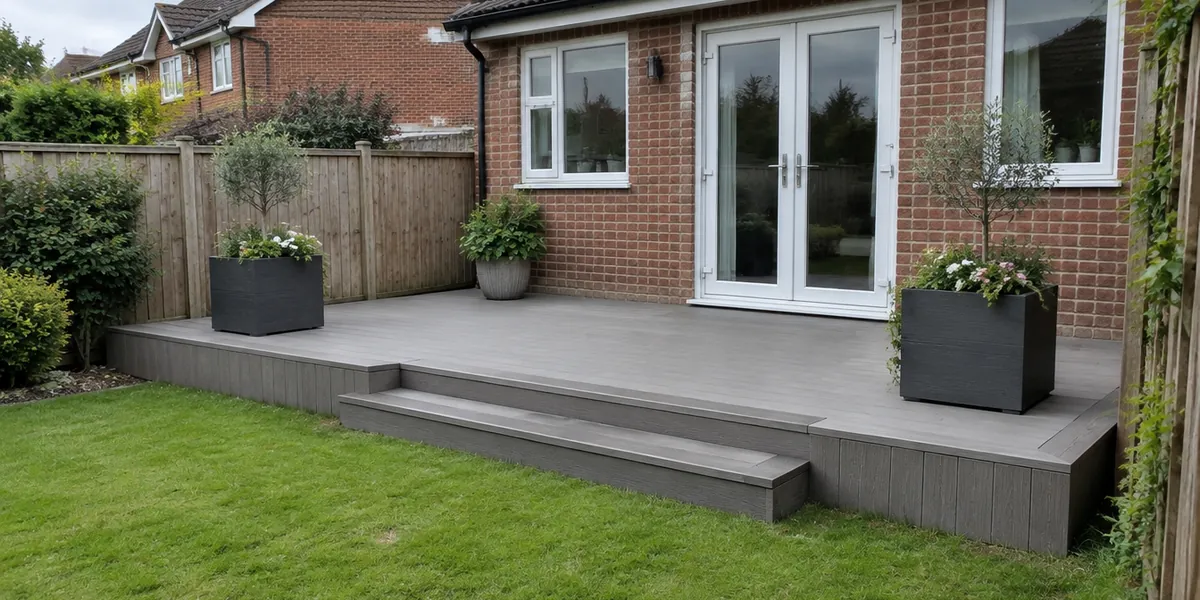
Composite decking boards are made from wood fibre bound in plastic, usually with a hard outer cap that resists staining, fading and scratches. They do not rot, splinter or need oiling, and they come in consistent colours and wood-effect finishes. Composite is the right choice for anyone who wants a deck without annual maintenance, for decks where children play barefoot, and for shaded gardens where timber turns green.
Composite boards are less stiff than timber, so they need joists at the spacing the manufacturer sets, typically 300 to 400 mm, and we follow those instructions exactly so the product warranty stays valid. We build the frame in treated timber or aluminium joists, fix the boards with the manufacturer's hidden clips so no screws show, and leave the specified expansion gaps at board ends and against walls, because composite expands and contracts with temperature.
There are trade-offs. Dark boards can get hot underfoot in full sun, the cheapest uncapped boards can stain and fade, and fascia boards and trims need careful cutting to finish the edges neatly. Composite is also heavier than softwood, which matters on raised decks. We bring samples from several ranges so you can feel the surface and compare colours in daylight in your own garden.
What You Get When We Handle Your Decking Installation
A deck that sags, bounces or goes soft at the edges nearly always has a problem with the frame, not the boards. We build frames to the board manufacturer's spacing, use treated timber rated for where it sits, fix with stainless or coated screws and leave room for air to move underneath. Those details are written into the quote.
We also look after the house. A deck against the back wall must finish at least 150 mm below the damp-proof course, must not cover or block air bricks, and should not trap water against the brickwork. If the height you want would put the deck more than 30 cm above the ground, we explain the planning position before you spend anything on drawings.
Our team also handles patio installation, fencing and gates, and garden border and edging installation, so a deck can sit alongside paving, a new boundary and planting as one planned job. Waste goes with us as registered waste carriers, and every deck comes with a written guarantee.
Decking Installation: Step by Step
- Survey: we measure the area and check levels, the damp-proof course, air bricks, drains and the height the deck will sit at.
- Design and quote: we agree shape, levels, steps and board type, and give a written quote with the frame specification and samples.
- Ground preparation: the area is cleared and levelled, a weed membrane is laid and covered with gravel, and footings or pedestal bases go in.
- Frame: posts, bearers and joists are fixed level at the correct centres, with noggins for stiffness and a slight fall away from the house.
- Boarding: boards are laid with even gaps and fixed with screws or hidden clips, and cut ends are treated.
- Finishing: fascias, steps, balustrades and any lighting conduits are fitted, then the deck is cleaned and the site cleared.
Most ground-level decks in Dewsbury take two to five days; multi-level decks, steps and balustrades add time. New softwood is best oiled once it has had a few weeks to dry, so we tell you when to apply the first coat.
Decking Installation in Dewsbury: What Changes the Price
The board material makes the largest difference. Treated softwood is the economical choice, composite costs more to buy but saves on future upkeep, and hardwood sits at the top because of both the timber and the extra time spent pre-drilling. Board width and the choice of hidden clips or face screws also change the figure.
Height and ground conditions come next. A low deck on level ground needs a simple frame; a raised or multi-level deck on a slope needs more posts, footings and bracing, plus steps and balustrades. Where a deck would rise above 30 cm, a planning application adds time and fees.
Shape and layout affect labour, since diagonal boards, picture-frame borders and curves mean more joists and more cutting. Removing an old deck or patio first, access through the house or a narrow side passage, built-in lighting and fascia boards are all extras that appear as separate lines on our quote.
Decking Installation Across Dewsbury
Our decking team works throughout Dewsbury, in Thornhill, Ravensthorpe, Earlsheaton, Chickenley and Savile Town, and across nearby Batley, Ossett and Heckmondwike. If your garden slopes away from the house, a deck can create a level seating area without the retaining walls a patio would need. If your plot is small, a low platform outside the back doors can make better use of the space. If your garden is overlooked, we can pair the deck with new fencing and gates or a screen, kept within the permitted height limits.
Related services we offer across Dewsbury include hard landscaping and garden wall construction.
Frequently Asked Questions
Do I need planning permission for decking in Dewsbury?
Usually not, provided the deck is no more than 30 cm above the ground and meets the other permitted development conditions. Any deck higher than 30 cm needs planning permission, as do decks at listed buildings, and conservation areas can have extra controls. We measure the proposed height at the survey and tell you which applies before you commit.
How long does decking last?
It depends on the material, the frame and the upkeep, so we do not quote a set lifespan. Treated softwood lasts well with regular cleaning and oiling, hardwood is naturally more durable, and composite does not rot. In every case the frame, ventilation and drainage underneath matter as much as the boards on top.
Is composite decking slippery?
Good capped composite boards have a textured surface and generally grip better than smooth timber when wet. Any outdoor surface can get slippery if algae or leaves build up, especially in shade, so a scrub with a stiff brush and soapy water a few times a year helps. We can suggest boards with a stronger anti-slip texture for steps and shaded areas.
Can decking go right up against the house?
Yes, with care. The deck surface must sit at least 150 mm below the damp-proof course, it must never cover or block air bricks, and there should be a small gap between the frame and the wall so water drains away. We fix a ledger board to the wall only where the brickwork is suitable; otherwise the frame stands free on its own posts.
How do I look after a softwood deck?
Sweep it regularly, clear leaves before they rot, and scrub it with a deck cleaner each spring. Every year or two, once the timber is dry, apply a decking oil or stain to keep water out and the colour even. Check for lifted screws and tighten or replace them, and treat any new cut ends with preservative.