If you live in Earlsheaton, Chickenley or anywhere else in Dewsbury, we can quote for gravel driveway resurfacing; we also cover nearby Batley, Ossett and Heckmondwike. Every quote in Dewsbury covers the base, edges and drainage as well as the surface, so you know what is causing the problem before you pay to fix it.
Every gravel drive thins out eventually. Stone gets carried away on tyres and shoes, sinks into the base and washes to the edges, and after a few years you are looking at bare patches, mud and weeds. Dewsbury Landscaping & Driveways provides gravel driveway resurfacing for homeowners across Dewsbury: a regrade of what is there followed by a fresh top dressing of gravel or crushed stone, laid to the right depth over a firm base. It is for anyone whose gravel drive is sound underneath but has lost its surface.
Resurfacing is different from repair. Repair deals with a pothole here or a rut there. Resurfacing renews the whole surface in one go, which is the sensible route when the stone has thinned across the drive, when you want to change the colour or type of gravel, or when weeds and dirt have mixed into the old stone so much that it no longer drains or looks clean.
We do more than tip a load of shingle and rake it about. The old surface is cleaned and regraded, the base is checked and firmed, edges are made good and the new stone is spread evenly and compacted. Done that way, a resurfaced gravel drive in Dewsbury looks like new and stays that way for years with only light raking.
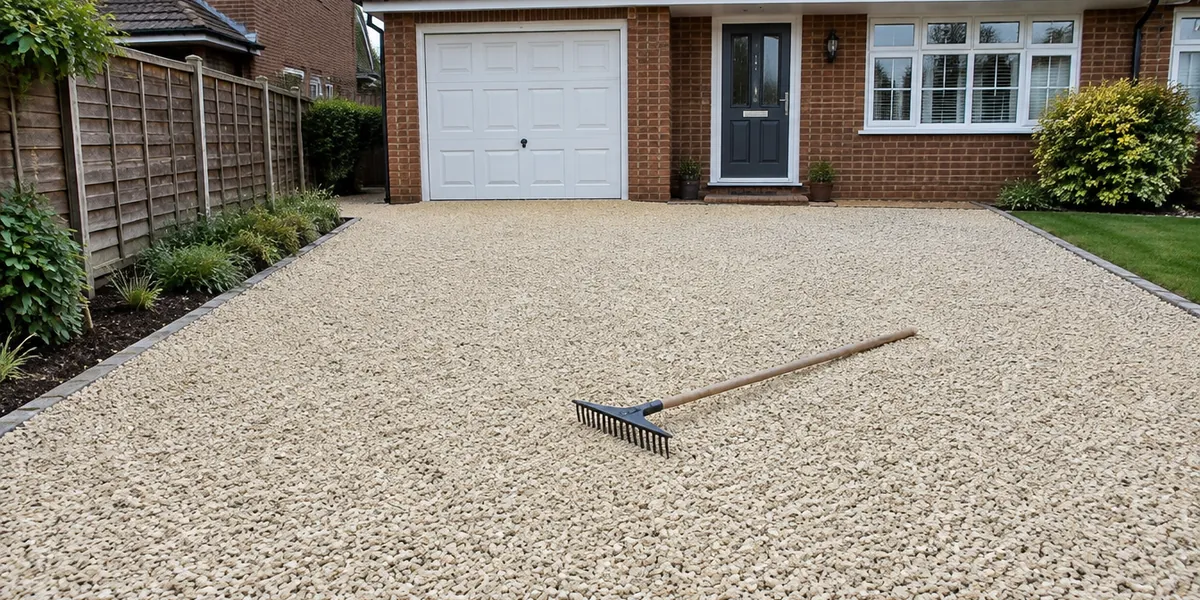
Gravel Top Dressing
Gravel top dressing is the renewal of a drive's surface with fresh decorative gravel, the rounded or part-rounded stone most people picture when they think of a gravel drive: golden shingle, pea gravel, flint, Cotswold-style buff chippings or a slate. It is the right choice for drives across Dewsbury where the look matters, where the drive is reasonably flat, and where the existing surface is the same type of stone and simply needs topping up or refreshing.
The job starts with assessing what is there. We rake back the old gravel and check its depth and condition. If it is clean and still loose we regrade it, pulling stone back from the edges and ridges into the thin areas and compacting it to make a consistent layer. If it has become clogged with soil, leaf mould and weed roots, we scrape the dirty top layer off and dispose of it under our waste carrier registration, because new gravel over a muddy mat will go the same way within a season.
Beneath the gravel we want to find a firm base and, ideally, a geotextile membrane. Where the base is soft we top it up with Type 1 MOT and compact it. Where there is no membrane we lay one, which stops the new gravel disappearing into the ground and slows weed growth. Edges are checked and timber, steel or concrete edging installed where stone has been escaping.
The new gravel is then delivered loose or in bulk bags, spread with shovels and a landscape rake to a depth of around 30 to 50 mm, graded to a slight camber so water runs off, and compacted with a vibrating plate to settle it. We match the size to the use: 10 mm stone is comfortable to walk on but travels on tyres, while 20 mm stays put better under cars and is our usual recommendation for a Dewsbury drive.
Crushed Stone Top Dressing
Crushed stone top dressing uses angular, quarried stone such as granite, limestone or basalt chippings instead of rounded gravel. The sharp edges lock together under compaction, so the surface holds its shape under tyres far better than shingle, resists rutting and stays put on gentle slopes. It is the choice we recommend for drives in Dewsbury that take daily car traffic, for longer drives, for anywhere ruts have been a problem, and for drives that have to carry the occasional delivery lorry or caravan.
Preparation follows the same principles as for gravel. The old surface is raked back and assessed; clean stone is regraded and reused, dirty stone is removed. The base is probed and firmed with compacted Type 1 MOT where needed, and a membrane laid if there is none. On sloping drives and at the entrance we often fit a plastic stabilisation grid filled with the new stone, which stops migration even on an incline.
The crushed stone is spread to 30 to 50 mm and compacted with a plate or roller. Because the particles interlock, the compacted surface is firm enough to push a wheelbarrow or a pram across without sinking, which is one of the reasons people choose it over rounded gravel. We use a mix of sizes where the drive is long, a slightly coarser stone in the running tracks and a finer dressing on top for appearance.
Crushed stone comes in a wide range of colours, from pale grey granite and warm buff limestone to dark basalt and red granite, so it does not have to look utilitarian. It is usually a little cheaper per tonne than decorative shingle from the same supplier, and it needs less raking over its life. If the drive edges onto a lawn we recommend a proper edging strip, because angular chippings are hard on mower blades.
What You Get When We Handle Your Gravel Driveway Resurfacing
Any builders' merchant will drop a bulk bag of gravel on your drive, and any lad with a rake can spread it. The difference with Dewsbury Landscaping & Driveways is that we treat the surface as the last step rather than the only one. We check and firm the base, lay a membrane, sort the edges and get the falls right, so the new stone stays where it was put.
We quote in writing, we supply stone from reputable local quarries and merchants, and we are honest about quantities so you are not paying for tonnes you do not need. We hold public liability insurance and a registered waste carrier licence for the old stone and spoil we take away.
Because we also build and repair gravel, block paving, tarmac and resin-bound drives across Dewsbury, we can advise on whether a fresh top dressing is the right spend or whether your drive would benefit from a stabilisation grid, new drainage or a different surface altogether. Our structural work carries a written guarantee.
How Our Gravel Driveway Resurfacing Works
- Survey: we measure the drive, check the depth and condition of the existing stone, probe the base and look at edges and drainage.
- Written quote: an itemised quote for the regrade, any base and edging work, membrane, stone type and quantity.
- Rake back and clean: sound gravel is raked aside for reuse and dirty, weed-filled stone is scraped off and removed.
- Base work: the base is firmed with compacted Type 1 MOT where soft, levels are corrected and a geotextile membrane is laid if there is none.
- Edging and grids: new edging is installed where stone has been escaping and stabilisation grids fitted on slopes or heavy-use areas if specified.
- Top dressing: the new gravel or crushed stone is spread evenly to depth, raked to a camber and compacted.
- Tidy and handover: surplus stone is bagged for your future top-ups, the site is swept and we hand over any written guarantee.
A typical gravel driveway resurfacing in Dewsbury takes a day, or two for longer drives and those needing base or edging work. Dry weather makes compaction easier, so spring to autumn is ideal.
How Gravel Driveway Resurfacing Is Priced in Dewsbury
The size of the drive sets the stone quantity and most of the labour, and the depth we need to lay to make up the shortfall affects the tonnage. The type of stone is the next factor: a local crushed limestone or granite costs less per tonne than a decorative Cotswold chipping, a Scottish pebble or a slate, and the price difference adds up over a large drive.
What we find under the old surface matters. A drive with a sound base and a membrane needs little more than a regrade and the new stone, whereas a drive that has never had either needs Type 1 MOT, membrane and more time. Removing and disposing of dirty old gravel costs more than reusing clean stone.
Edging, stabilisation grids and drainage are listed as separate items. Access in Dewsbury affects delivery, because a grab lorry tipping straight onto the drive is cheaper than bulk bags craned over a wall and barrowed through.
Gravel Driveway Resurfacing Across Dewsbury
We resurface gravel drives in every part of Dewsbury. If you have a long drive in Thornhill, crushed stone top dressing is usually the right choice, while in Ravensthorpe and Earlsheaton we refresh plenty of small gravelled frontages with decorative shingle. If your plot in Chickenley slopes, we combine resurfacing with grids and edging, and in Savile Town we take on a mix of both. Homeowners in the rest of Dewsbury and nearby Batley, Ossett and Heckmondwike are welcome to call for a visit and a written quote.
Homeowners in Dewsbury often ask us about concrete driveway resurfacing and tarmac driveway resurfacing at the same time.
Common Questions
How often does a gravel driveway need resurfacing?
On a Dewsbury drive with a proper base and membrane, a top dressing every four to six years is typical, with light raking and the odd bucket of stone in between. Drives laid straight onto soil need it far more often because the stone keeps sinking. Crushed stone generally lasts longer between dressings than rounded gravel because it moves less.
Can you lay new gravel over the old gravel?
Yes, if the old stone is clean and loose. We regrade it, compact it and dress over it, and the new layer binds in with the old. If the old gravel has become a mat of mud, moss and weed roots, we scrape that layer off first, because new stone laid over it will quickly go the same way and will not drain.
Which is better for a driveway, gravel or crushed stone?
Crushed stone is better for durability: its angular pieces lock together, resist ruts and stay put on slopes. Rounded gravel has a softer look and a wider choice of colours but travels more under tyres. For a short, flat drive with light use either is fine. For daily car use or any slope we recommend crushed stone or a stabilisation grid.
How much gravel do I need for my driveway?
As a rule of thumb, a 20 mm stone laid at 40 mm depth uses roughly one tonne for every 12 to 14 square metres. We measure the drive and the existing depth at the site visit and work out exactly what is needed to bring it up to 30 to 50 mm, so you are not paying for stone that ends up in a pile at the side.
Do I need a membrane under my gravel driveway?
We strongly recommend one. A geotextile membrane between the base and the gravel stops the stone sinking into the ground, keeps soil from working up into the gravel and slows weed growth from below. It will not stop weeds seeding from above, but those are shallow-rooted and easy to deal with. We lay one on any resurfacing job where there is none.