We provide tarmac driveway resurfacing throughout the WF12 and WF13 postcode districts of Dewsbury, from Earlsheaton to Ravensthorpe, and in nearby Batley, Ossett and Heckmondwike. We check the base and the drainage on every Dewsbury drive we price, because the surface is rarely the whole story.
When a tarmac drive has gone grey, crazed and loose across most of its surface, patching individual holes stops making sense. Dewsbury Landscaping & Driveways offers tarmac driveway resurfacing to homeowners across Dewsbury: a new hot-laid wearing course over the existing drive that gives you a fresh black surface for a fraction of the cost of digging the old one out. It is for drives where the base is still firm but the top layer is finished.
Tarmac is laid in layers. The base course does the structural work and the wearing course, the top 25 to 40 mm, takes the weather and the tyres. The wearing course wears out first, and on drives around Dewsbury that usually happens somewhere between fifteen and twenty-five years in. Replacing just that layer is what resurfacing means.
We offer two ways of doing it. A straight overlay goes on top of the existing surface and raises the level. Plane and overlay removes the old wearing course first so the new one sits at the original height, which matters where the drive meets a garage floor, a damp-proof course or the public footway. We tell you which is right for your drive at the site visit.
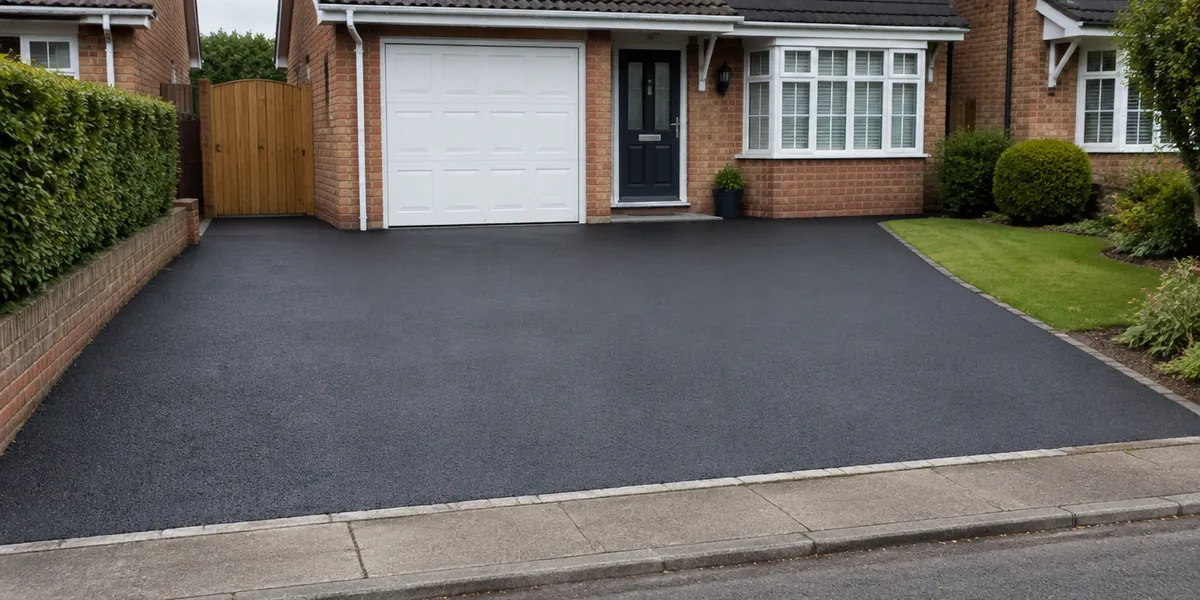
Tarmac Overlay
A tarmac overlay is the simplest form of resurfacing. The existing drive stays in place and becomes the base for a new wearing course laid directly on top. It is the right choice for a Dewsbury drive that is level and firm, with no major potholes or sunken areas, where raising the surface by 25 to 40 mm will not cause problems at thresholds, garage doors or the pavement edge.
Preparation is lighter than for a new drive but it still matters. We sweep and pressure wash the old surface to remove moss, dust and loose stone, because the new layer must bond to clean tarmac. Potholes and cracks are cut out and filled with hot macadam so the overlay goes onto an even surface. Where the old drive has crumbling edges we install a concrete kerb or block edging on a concrete haunch before laying, otherwise the new tarmac has nothing to compact against.
The old surface is sprayed with a bitumen emulsion tack coat and left to break, which takes around half an hour on a dry day. We then lay hot 6 mm or 10 mm dense bitumen macadam, raked to an even depth and compacted with a twin-drum roller and a vibrating plate at the edges. Falls are checked as we go so water runs to a gully or the road rather than pooling in the middle. The edges are tamped to a neat chamfer and the surface is left to cool overnight before any cars go on it.
The finished overlay looks and performs like a new drive. If you want the surface to stay black and sealed for longer, a seal coat after a year or two of weathering is worthwhile, and a red or buff-coloured wearing course is an option if plain black is not to your taste.
Plane and Overlay Resurfacing
Plane and overlay resurfacing removes the worn wearing course with a planing machine before the new one goes down, so the finished level is the same as before. It is the method we recommend on Dewsbury drives where an overlay would bring the surface too close to the damp-proof course of the house, lift it above a garage threshold or create a lip at the edge of the public footway. It also deals with a surface that is too broken up to overlay reliably.
Planing is done with a small cold planer, which has a rotating drum of tungsten teeth that mills the tarmac away to a set depth, usually 25 to 40 mm. The planings are loaded straight into a skip or grab lorry under our waste carrier registration, or, if you have a use for them, kept on site as a useful hardcore for paths and bases. On very small drives or around tight obstructions we use a floor saw and breaker instead of a planer.
With the old wearing course gone we inspect the base course beneath. Any soft or broken areas are cut out, the sub-base is made good with compacted Type 1 MOT and a fresh base course is laid in those spots. Edges are checked and new kerbs installed where needed. The whole planed surface is then swept clean, tack-coated and overlaid with hot dense macadam exactly as described above, compacted and finished to the original levels.
Plane and overlay takes a day longer than a straight overlay and costs more because of the machine hire and waste. In return you keep your levels, get a chance to repair the base course properly and end up with a drive that is as good as new from the base course up.
Why Choose Us for Tarmac Driveway Resurfacing in Dewsbury
The quality of a tarmac drive comes down to three things: hot material from a reputable plant, proper compaction while it is still hot, and edges that are restrained. Dewsbury Landscaping & Driveways gets all three right. We collect hot macadam on the day, lay it with the right plant for a domestic drive and never lay against an unrestrained edge.
We are local, insured and registered to carry waste, and every job begins with a written, itemised quote. We measure the drive, check levels against your thresholds and the footway, and tell you plainly whether a straight overlay or plane and overlay is right. If the base course has failed and resurfacing is not a good use of your money, we say so and quote for a new drive instead.
Our resurfacing work carries a written guarantee. We also install block paving, gravel and resin-bound surfaces across Dewsbury, so if you want to compare tarmac with something else we can give you a like-for-like quote.
How Our Tarmac Driveway Resurfacing Works
- Site survey: we check the condition of the base, measure the drive and check levels at the house, garage and footway to choose between overlay and plane and overlay.
- Written quote: an itemised quote covering preparation, edging, any base repairs, the wearing course and waste removal.
- Preparation: the surface is cleaned, potholes and cracks cut out and filled, and failed edges replaced with new kerbs on a concrete haunch.
- Planing: on plane and overlay jobs the old wearing course is milled off and removed, and the base course is inspected and repaired.
- Tack coat: the prepared surface is sprayed with bitumen emulsion and left to break.
- Laying and compaction: hot dense macadam is laid to depth, raked, rolled and plate-compacted at the edges, with falls checked throughout.
- Cooling and handover: the drive is left to cool overnight, the site is cleared and you receive the written guarantee.
Most tarmac driveway resurfacing jobs in Dewsbury are finished in one to two days. We lay in dry weather above about 5°C, so spring to autumn is the usual window, though mild winter days are fine too.
How Tarmac Driveway Resurfacing Is Priced in Dewsbury
Area is the main factor, because hot macadam is priced by the tonne and a wearing course at 30 mm uses a predictable amount per square metre. The method comes next: plane and overlay adds machine hire, labour and waste disposal compared with a straight overlay.
The condition of the existing drive affects preparation time. A clean, level surface needs little beyond washing and tack coating, while a drive with crumbling edges, deep potholes and soft spots needs edging, cutting out and base repairs before any resurfacing can start. New kerbs are priced per metre.
Access across Dewsbury varies and so does the cost. A drive we can reach with a roller and a grab lorry is quicker than one where material has to be barrowed through a gate. Coloured wearing courses, a seal coat and drainage channels are all extras that we list separately on the quote.
Tarmac Driveway Resurfacing Throughout Dewsbury
We resurface tarmac drives throughout Dewsbury. In Thornhill and Ravensthorpe, if your drive sits well below the damp-proof course and has room to come up, a straight overlay is the simplest option. In Earlsheaton and Chickenley, if a garage or threshold is tight and the surface cannot rise, we plane and overlay instead. If you have a longer drive in Savile Town, resurfaced tarmac makes most sense against the cost of block paving. We cover the rest of Dewsbury and nearby Batley, Ossett and Heckmondwike as well, so get in touch wherever you are.
If this is part of a bigger project, see our pages on concrete driveway resurfacing and gravel driveway resurfacing.
Frequently Asked Questions
Can every tarmac driveway be resurfaced?
Only if the base course and sub-base are still firm. Resurfacing replaces the top layer, so if the drive is sinking, rutting under cars or heaving from roots, a new wearing course will follow the same movement. We probe the base on the site visit. Surface problems like greying, crazing, loose stone and isolated potholes are all fine to resurface over.
How thick is a new tarmac wearing course?
A domestic driveway wearing course is usually laid at 25 to 40 mm compacted thickness using 6 mm or 10 mm dense bitumen macadam. Thinner than that and it will not compact properly or last; thicker is unnecessary over a sound base. Where we plane first we remove roughly the same depth so the finished level matches the original.
How long before I can park on a resurfaced tarmac driveway?
Overnight in most conditions. Hot macadam must cool right through before it can take the weight of a car, and in warm summer weather we may ask for a full 24 hours. Avoid turning the steering wheel while stationary and keep jacks, ladders and motorbike stands off the surface for the first few weeks, as tarmac stays slightly soft until it has fully hardened.
What happens to the old tarmac if you plane it off?
The planings are removed under our registered waste carrier licence and go for recycling into new road material. If you have a use for them, such as a base for a garden path or shed, we can leave them on site. Planings compact well and are a good free hardcore for jobs in Dewsbury where appearance does not matter.
Do I need planning permission to resurface a tarmac driveway?
No. Resurfacing an existing drive is maintenance. The permeable surface rules only apply when you create a new impermeable area larger than 5 m² in a front garden. If your drive discharges water onto the public footway, though, it is worth letting us add a channel drain at the entrance while we have the surface up, as the council can ask for that.